Protecting sensitive data is no longer optional. With laws like GDPR, HIPAA, and CCPA, organizations must prioritize privacy while maintaining data usability. This article reviews the 10 best AI-powered data anonymization tools for 2025, designed to help businesses safeguard personal information against breaches and comply with global regulations.
Key Takeaways:
- AI-driven anonymization is critical as traditional masking methods fail against advanced re-identification attacks.
- Tools like DataGuard, PrivacyPlus, and IBM Guardium offer advanced features such as synthetic data generation, differential privacy, and real-time masking.
- Open-source options like ARX and Google TensorFlow Privacy provide cost-effective solutions for developers and researchers.
- Pricing and target users vary widely, from enterprise-grade platforms like k2view to small-business-friendly tools like PrivacyPal.
Quick Overview:
- DataGuard: AI-powered masking and compliance tracking for healthcare, finance, and retail.
- PrivacyPlus: Context-aware anonymization with flexible pricing tiers.
- AnonyTech: Differential privacy and deep learning for sensitive medical and financial data.
- DataSafe: Oracle’s solution for database masking and monitoring.
- ClearMask: NLP and CV-based anonymization for structured and unstructured data.
- PrivacyPal: Budget-friendly browser extension for startups and SMBs.
- k2view: Entity-based masking with strong compliance features for large enterprises.
- Google TensorFlow Privacy: Open-source differential privacy for machine learning.
- ARX: Free, flexible anonymization tool for researchers and technical teams.
- IBM Guardium: Enterprise-grade platform with real-time monitoring and adaptive protection.
Why It Matters:
In 2024, 277 million healthcare records were breached in the U.S. alone, underscoring the urgency of adopting advanced data protection methods. These tools help organizations balance privacy, compliance, and data utility, ensuring sensitive information stays secure without sacrificing functionality.
For a detailed breakdown of features, pricing, and compliance support, keep reading.
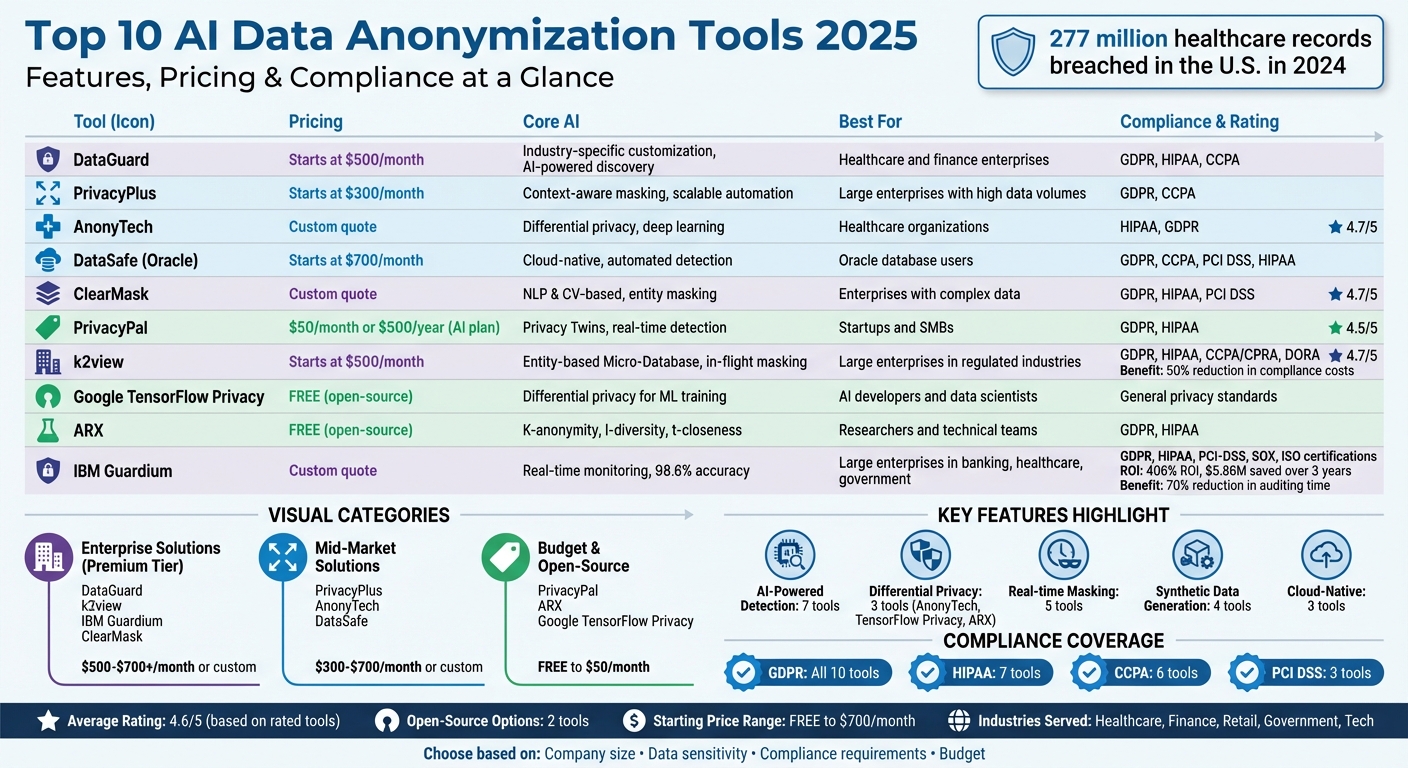
Top 10 AI Data Anonymization Tools 2025: Features, Pricing & Compliance Comparison
Data anonymization with AI: Your Data’s Personal Guardian
1. DataGuard
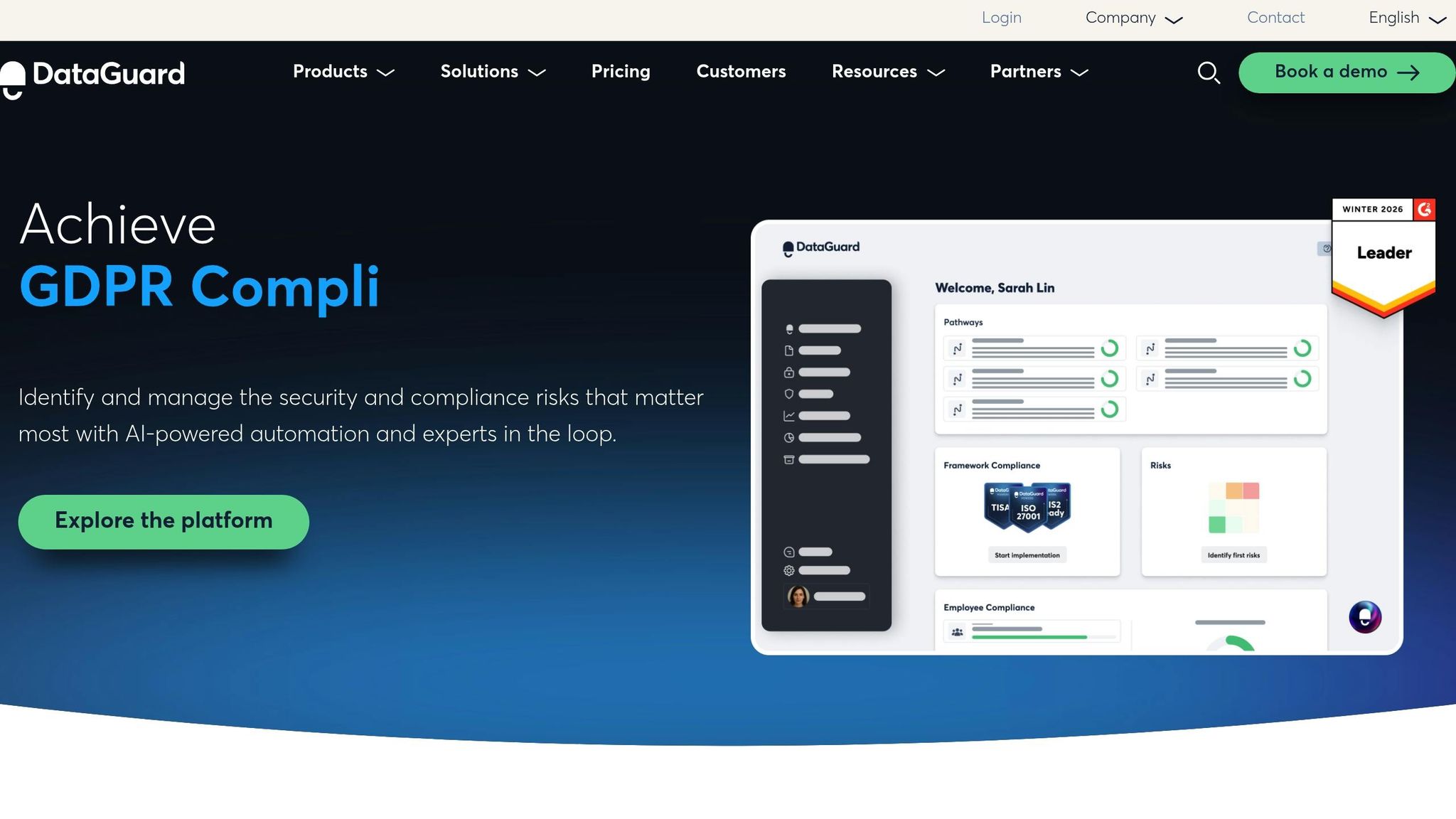
DataGuard is a platform designed to streamline enterprise data governance, combining AI-powered anonymization with automated compliance monitoring. By integrating data masking with compliance tracking, it provides a solution for organizations juggling multiple regulatory requirements. Let’s dive into what makes this tool stand out.
Key AI Features
At its core, DataGuard employs context-aware natural language processing (NLP) to identify and mask sensitive data across both structured and unstructured sources. What sets it apart is its ability to differentiate context – like recognizing a person’s name versus a similar text string – ensuring both data security and integrity remain intact across all systems.
Target Audience
DataGuard is built for data leaders, including Chief Data Officers and Data Quality Managers, who need centralized control over governance processes. Its user-friendly dashboards offer a clear, comprehensive view of compliance metrics, simplifying the task of monitoring and maintaining regulatory standards. Industries like healthcare, finance, and retail, which handle high volumes of sensitive data, can benefit from its well-rounded approach.
Compliance Support
The platform supports key regulations such as GDPR, CCPA, and HIPAA by automating consent and policy updates. Its Consent & Preference Management (CPM) module takes the hassle out of compliance by automatically generating and updating privacy policy records. This feature is especially valuable for organizations operating across multiple jurisdictions, as it significantly reduces the compliance workload.
Pricing (US$)
DataGuard operates on a custom enterprise pricing model, typical for AI-driven data protection tools. Costs are tailored based on factors like data volume and the number of users. While specific pricing details aren’t publicly disclosed, interested organizations can request a demo to explore how pricing aligns with their needs.
2. PrivacyPlus
PrivacyPlus takes a layered approach to securing sensitive data by combining advanced AI detection with various anonymization techniques. This strategy boosts accuracy while minimizing the risk of re-identification. Let’s dive into the standout features that make PrivacyPlus a powerful tool for anonymization.
Key AI Features
PrivacyPlus uses context-aware AI detection powered by pre-trained NLP and CV models. Unlike simpler regex-based systems, this approach understands the context of the data, leading to fewer false positives or negatives. It supports several anonymization methods, including masking, pseudonymization, generalization, suppression, and synthetic data generation. A noteworthy feature is its Format-Preserving Pseudonymization (FPP), which retains the original data structure, making it ideal for testing and analytics.
Target Audience
The platform is designed to cater to a wide range of users, from solo developers to large enterprises. PrivacyPlus offers multiple editions, allowing users to start small and expand as needed without overhauling their code or architecture. For teams hesitant to commit upfront, there’s even a free tier, making it easy to test the platform before investing.
Compliance Support
PrivacyPlus simplifies compliance with major regulations through automated regulatory mapping and pre-built policy templates. These templates cover GDPR (all PII categories), HIPAA (all 18 PHI identifiers), and PCI DSS requirements. To meet strict mandates, the platform uses irreversible anonymization techniques, ensuring it aligns with GDPR’s "right to be forgotten" provisions where reversible methods fall short.
Pricing
The platform offers a tiered pricing model that adjusts to the needs of organizations, ensuring flexibility as they grow.
3. AnonyTech
AnonyTech offers a proprietary rules engine paired with a customizable real-time classification system, designed to tag sensitive data as it flows through various systems.
Key AI Features
The platform leverages AI-driven anonymization and differential privacy to protect sensitive data while maintaining its analytical usefulness. With continuous data masking and deep learning capabilities, it’s particularly effective at managing complex datasets in industries like healthcare and finance.
On top of that, AnonyTech includes an end-to-end automated workflow for handling Data Subject Access Requests (DSARs), simplifying compliance-related tasks. This combination of features ensures a strong focus on both security and regulatory adherence.
Target Audience
AnonyTech is tailored for organizations dealing with sensitive medical or financial data, as well as tech companies in need of scalable automated privacy solutions. It supports both cloud-based and on-premise deployments. However, non-technical users might find the platform challenging to navigate initially.
Compliance Support
The platform automates data anonymization processes to help organizations meet GDPR, HIPAA, and CCPA standards. Its multi-language and multi-region support makes it easier for global teams to manage varying regulatory requirements. In a 2025 industry review, users gave AnonyTech a rating of 4.7 out of 5, highlighting its compliance strengths and its ability to handle complex datasets in highly regulated sectors.
Pricing
AnonyTech follows a custom pricing model. Companies interested in using the platform should reach out directly to the provider for a personalized quote.
4. DataSafe
Oracle Data Safe brings together tools for data discovery, masking, and monitoring across Oracle databases, whether they’re on-premises or in the cloud. It scans data dictionaries and database content automatically to pinpoint sensitive columns, covering categories like financial, healthcare, and biographic data. With support for over 125 predefined sensitive data types, it provides a thorough foundation for advanced AI-powered security features.
Key AI Features
One standout feature of Data Safe is its automated modeling, which maps relationships between primary and foreign keys. This ensures that data masking is consistent, even in complex database structures. Sensitive data is replaced with realistic, synthetic alternatives, allowing developers to work with accurate datasets while protecting personally identifiable information (PII).
By integrating with the Oracle AI Database 26ai kernel, Data Safe employs machine learning through its SQL Firewall to block SQL injection attacks and flag unusual account activity. Additionally, its User Assessment feature assigns risk scores based on user privileges and authentication methods, enhancing overall security.
Target Audience
Data Safe is tailored to meet the needs of organizations relying on Oracle databases, either on-premises or in Oracle Cloud Infrastructure (OCI). It’s particularly useful for compliance and security teams tasked with adhering to regulations like GDPR, HIPAA, or PCI DSS. DevOps and QA engineers also benefit, as the platform provides sanitized production data for development and testing. Guillaume Delannoy, CEO of Soho Media Solutions, highlighted its advantages:
"We use Data Safe to monitor and assess user activity inside the database…It’s very easy to implement and it’s very, very robust".
Compliance Support
The platform simplifies compliance reporting for regulations such as GDPR, CCPA, DPDPA, PCI DSS, and HIPAA. It also checks database configurations against Center for Internet Security (CIS) benchmarks and Security Technical Implementation Guides (STIG), ensuring alignment with government and defense-level security standards. Data Safe further manages audit policies and retains audit logs for up to seven years, aiding in long-term compliance and forensic investigations. Its excellence in data security earned it a "Leader" designation in the 2025 KuppingerCole Leadership Compass for Data Security Platforms.
Pricing
Data Safe is accessible through Oracle Cloud Free Tier for smaller-scale use. For enterprise needs, pricing is custom and depends on the number of target databases and the volume of audit data. For detailed pricing information, reach out to Oracle sales.
5. ClearMask
ClearMask takes a deep learning–driven approach to anonymizing data across both structured and unstructured datasets. By utilizing advanced Natural Language Processing (NLP) and Computer Vision (CV) models, it automatically detects new Personally Identifiable Information (PII) fields and suggests suitable masking patterns during development. This context-aware detection makes it a powerful tool for safeguarding sensitive data.
ClearMask builds on the advancements of AI-powered anonymization tools, using deep learning to enhance both the security of data and its usefulness.
Key AI Features
ClearMask actively scans datasets to identify sensitive information and recommends masking strategies in real time. What sets it apart is its ability to retain crucial data relationships, ensuring that the anonymized data remains useful for analysis. This balance between privacy and functionality makes it a strong choice for organizations sharing sensitive data.
Target Audience
ClearMask is tailored for large enterprises in industries such as healthcare, finance, insurance, and technology. It meets the needs of businesses requiring advanced anonymization solutions. The platform has received high ratings – 4.7/5 on G2, Capterra, and Trustpilot – where users highlight its ability to handle large-scale data protection. However, some users have expressed concerns about customer support responsiveness, and its higher cost may deter smaller organizations.
Compliance Support
ClearMask is designed to help organizations meet GDPR and CCPA requirements. It includes detailed reporting features for audit tracking and supports anonymization of both structured and unstructured data. This ensures comprehensive compliance coverage, making it suitable for industries with strict privacy regulations.
Pricing
ClearMask operates on a custom pricing model tailored to enterprise needs. Pricing depends on factors such as data volume and complexity, so interested organizations should contact the provider directly for a quote.
6. PrivacyPal
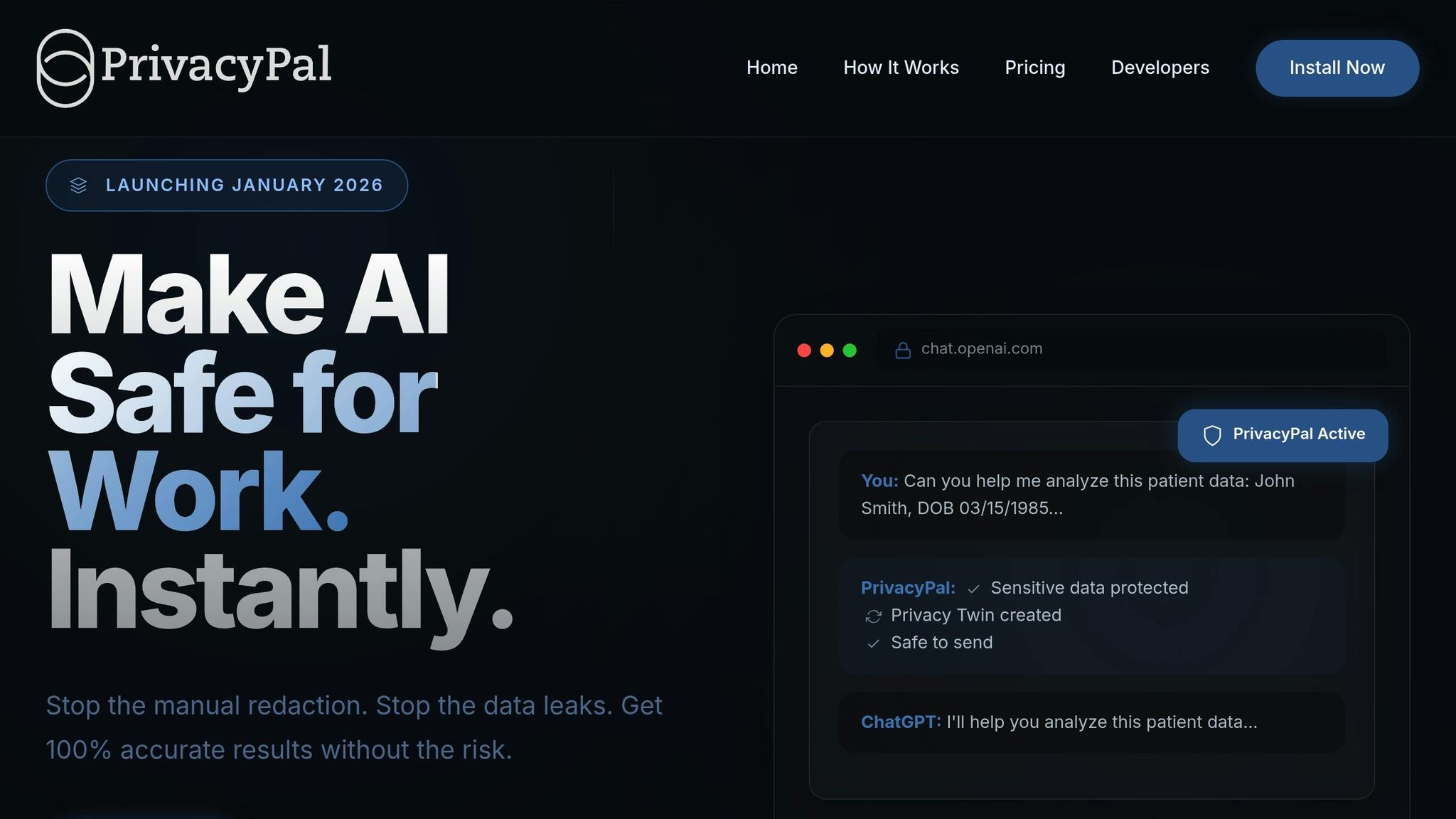
PrivacyPal is a budget-friendly, easy-to-use browser extension designed to provide real-time data protection for AI tools like ChatGPT and Claude. It’s an appealing choice for startups and small businesses that need to safeguard sensitive data while working with large language models.
Key AI Features
PrivacyPal employs "Privacy Twins", which are synthetic substitutes for sensitive data such as personal, financial, and health information. These substitutes are created before the data ever reaches AI models. Its AI engine works automatically, identifying and anonymizing sensitive information in real time – no setup required. For larger organizations, PrivacyPal goes beyond browser protection, offering internal database scanning (DSPM) and self-hosting options to ensure data sovereignty. Additionally, the tool is gearing up to support Agent-to-Agent (A2A) workflows, enabling secure data exchanges between AI agents.
Target Audience
PrivacyPal is tailored for tech startups, small businesses, and companies in sectors like e-commerce and fintech. It’s particularly effective for managing real-time consumer transaction data. Even non-technical users can start using it right away, thanks to its zero learning curve. With a 4.5/5 rating on platforms like G2, Capterra, and Trustpilot, users often highlight its affordability and ease of integration. However, some users have pointed out that it offers limited customization for more complex needs and may experience occasional slowdowns when processing very large datasets.
Compliance Support
The tool comes equipped with built-in support for GDPR and HIPAA compliance. Its real-time anonymization and encryption features make it easier for organizations to meet regulatory requirements. An intuitive dashboard provides actionable insights, helping businesses monitor their privacy practices and maintain compliance in industries like healthcare, e-commerce, and fintech.
Pricing
| Plan | Price | Target Audience | Key Features |
|---|---|---|---|
| PrivacyPal AI | $50/month or $500/year per seat | Individuals, Startups, Small Businesses | Browser extension, real-time detection, unlimited queries, email support |
| PrivacyPal Cloud | Starting at $12,000/year | Enterprises, Large Organizations | Includes 10 seats, self-hosting, DSPM, 24/7 dedicated support, data sovereignty |
For organizations with high data processing needs or a focus on data sovereignty, the Cloud/Enterprise plan is a strong choice due to its self-hosting capabilities.
sbb-itb-8421839
7. k2view
k2view is a robust platform designed for enterprise-level data anonymization, catering to organizations managing vast amounts of sensitive data from multiple sources. The company recently secured $15 million in funding to enhance its Agentic AI capabilities and was recognized as a Visionary in the 2024 Gartner Magic Quadrant for Data Integration Tools. These milestones highlight its commitment to advancing data management technology.
Key AI Features
k2view uses Large Language Models (LLMs) to identify, classify, and catalog sensitive data across various formats, including structured databases, PDFs, and images. Its patented entity-based masking system creates micro-databases for individual entities (like customers or orders), maintaining data relationships while reducing risk. The platform also includes an AI Chat Co-pilot, enabling users without technical expertise to define and oversee anonymization tasks using natural language. Additionally, it allows development teams to create compliant synthetic datasets for testing and AI model training. A no-code Data Agent Builder further simplifies the process of building Agentic AI applications with anonymized, AI-ready data.
Target Audience
k2view is tailored for large enterprises in regulated industries such as financial services, healthcare, and telecommunications. Trusted by major organizations like AT&T, Charles Schwab, and Sun Life, it excels in managing complex data environments. The platform is particularly valuable for teams involved in data protection, DevOps, QA, and data engineering, offering automated and compliant test data provisioning. Users have rated the platform 4.7/5, though they note that the initial setup requires careful planning.
Compliance Support
The platform is equipped to support essential data protection regulations, including GDPR, CCPA/CPRA, HIPAA, and DORA. It also adheres to international standards like LGPD (Brazil), PIPEDA (Canada), and APPI (Japan). Its in-flight anonymization ensures sensitive data is masked during transfers from production to target systems, preventing exposure in non-production environments. Additional compliance features include role-based and attribute-based access controls and automated audit logs for tracking and security.
Pricing
k2view’s pricing is structured with enterprises in mind. Its Standard Cloud Edition uses a consumption-based model, charging based on Micro-Database operations instead of per user. For instance, Micro-DB writes cost $4 per 100,000 bulks, reads are $2 per 100,000 bulks, and storage is priced at $0.50 per GB per month. Development environments start at $100 per month, while production clusters begin at $8,000 per month. A "Start Free" tier is available, but enterprise-level features like HIPAA support, PCI compliance, and VPC isolation require custom quotes.
8. Google TensorFlow Privacy
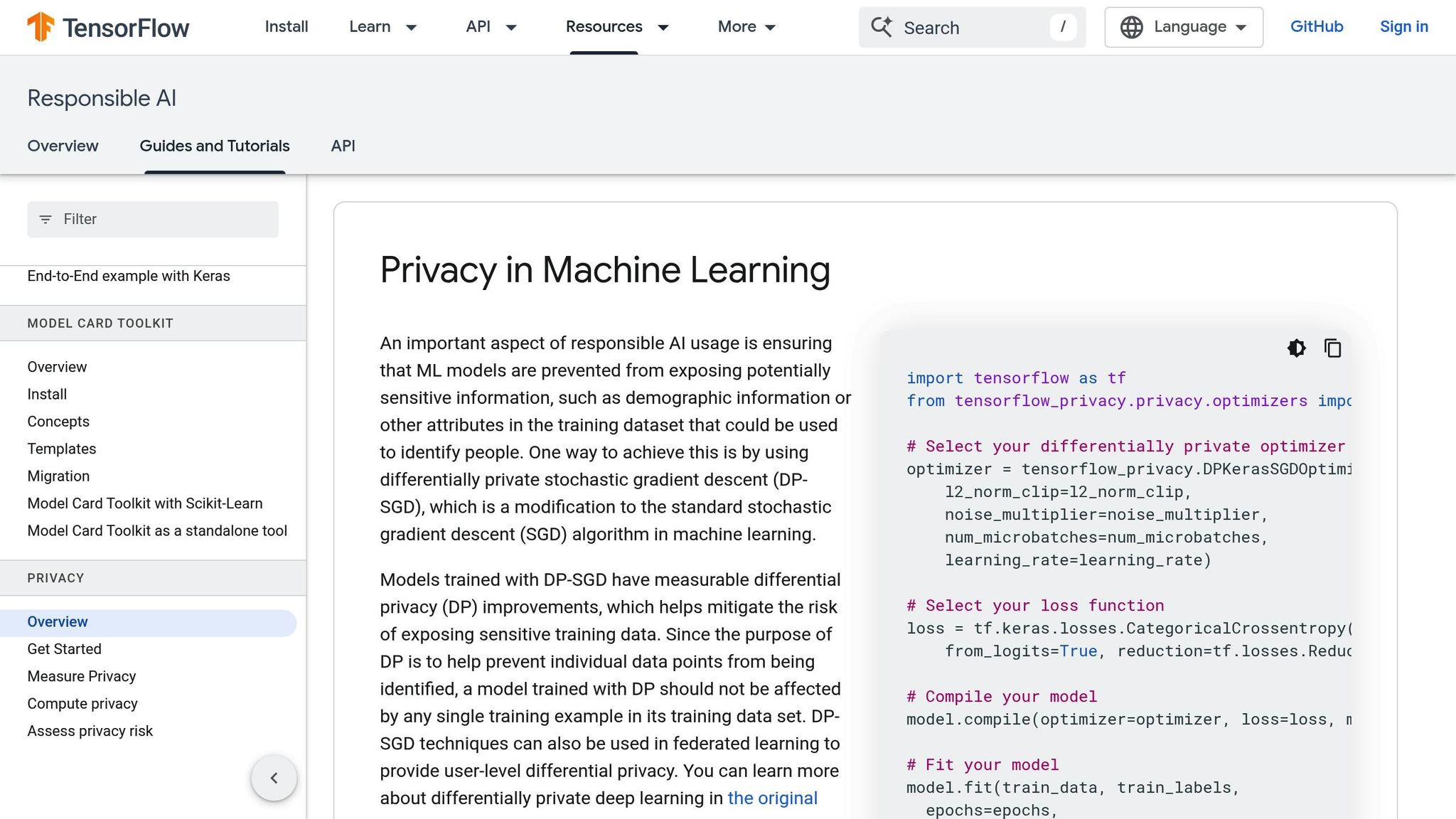
Google TensorFlow Privacy is an open-source library designed to bring privacy-preserving machine learning to life through differential privacy. It allows developers to train AI models while ensuring that individual data points remain secure and are not memorized or exposed during the process. Building on earlier anonymization tools, TensorFlow Privacy focuses specifically on safeguarding the training phase of machine learning models.
Key AI Features
TensorFlow Privacy relies on Differentially Private Stochastic Gradient Descent (DP-SGD), a technique that introduces controlled noise to gradients during training. This ensures that no single data point has an outsized influence on the model. Developers can easily integrate privacy-focused optimizers like DPKerasSGDOptimizer and DPKerasAdamOptimizer into their TensorFlow workflows with minimal adjustments.
The library also includes tools for Membership Inference Attack (MIA) testing, which simulate potential privacy breaches to assess re-identification risks. Additionally, it provides built-in privacy reports that visually demonstrate the balance between model accuracy and privacy protection (measured by epsilon), offering clear evidence of privacy compliance. DP-SGD methods can even be extended to federated learning setups, enabling user-level differential privacy.
Target Audience
TensorFlow Privacy is tailored for TensorFlow and Keras users, including machine learning practitioners, data scientists, and privacy researchers who need to safeguard sensitive data during model training. It’s especially valuable for organizations in highly regulated sectors like healthcare and finance, where privacy is paramount. These industries can leverage the library to build "Responsible AI" systems that comply with strict data minimization and privacy standards.
Pricing
As an open-source project, TensorFlow Privacy is completely free to use and is available on GitHub and PyPI. However, deploying it on managed cloud platforms like Google Cloud Vertex AI or BigQuery may incur standard service fees.
9. ARX
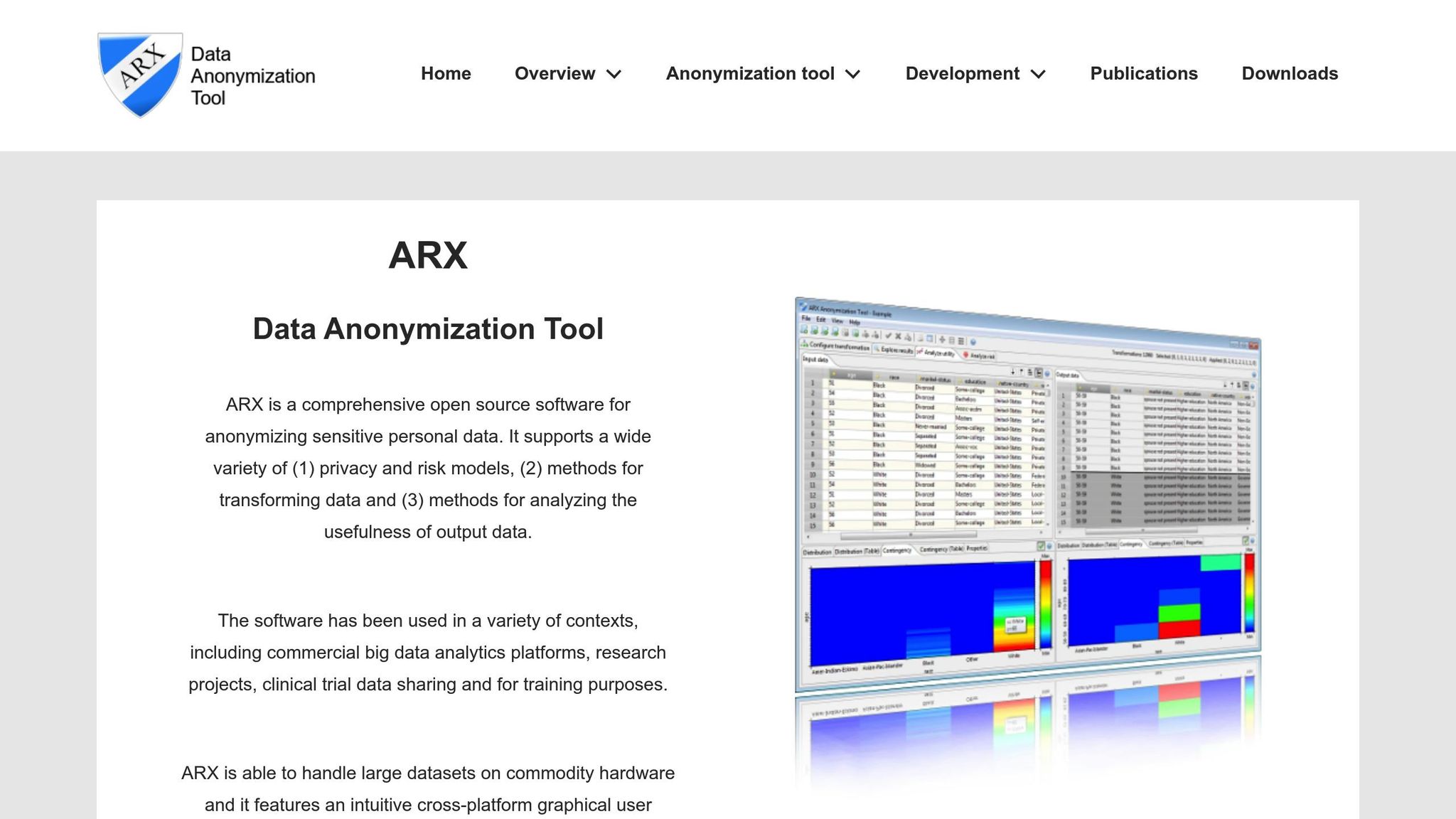
ARX is a free, open-source tool designed to provide robust privacy protection and flexible anonymization. It works seamlessly on any system with a Java Runtime Environment, offering both a user-friendly graphical interface for those without technical expertise and a Java API for automated processes. These features make it a versatile choice for balancing privacy and data utility.
Key AI Features
ARX incorporates workload-aware utility models, enabling users to evaluate how anonymized data performs in machine learning tasks. It offers detailed statistics and visualizations to help users understand the trade-offs between privacy and utility. A specialized Machine Learning Utility Analysis perspective further aids data scientists in assessing the impact of privacy measures on data usability.
The tool supports (ε, δ)-differential privacy and game-theoretic de-identification, striking a balance between safeguarding privacy and maintaining data usefulness. Its heuristic search strategies are particularly effective at handling high-dimensional datasets, identifying near-optimal anonymization solutions efficiently.
Target Audience
ARX is ideal for a range of users, including researchers, data scientists, clinical trial managers, and businesses that prioritize privacy. Its flexibility and open-source nature ensure there’s no vendor lock-in. Healthcare organizations, for instance, can rely on its HIPAA Safe Harbor method, which automatically identifies and modifies the 18 identifiers needed for compliance. Developers can integrate ARX into larger data analytics platforms using its Java API, while non-technical users benefit from guided wizards that simplify the anonymization process, such as categorizing continuous variables.
Compliance Support
ARX is a valuable tool for organizations aiming to meet GDPR, HIPAA, and CCPA requirements. It employs anonymization techniques that ensure individuals cannot be re-identified. The tool’s risk analysis perspective evaluates re-identification risks across various attack models, such as those posed by prosecutors, journalists, or marketers, helping users confirm regulatory compliance. For HIPAA, ARX specifically detects the Safe Harbor identifiers that require modification, while GDPR compliance is supported through k-anonymity and differential privacy models.
10. IBM Guardium
IBM Guardium is a robust data security platform designed for organizations in highly regulated sectors like banking, healthcare, retail, and government. It offers more than just static data masking, providing real-time monitoring and adaptive protection across hybrid cloud environments – perfect for managing large volumes of sensitive data.
Key AI Features
Guardium leverages AI-powered discovery and classification to automatically scan hybrid cloud environments, pinpointing sensitive data that needs protection or anonymization. It achieves 98.6% accuracy for structured data and a flawless 100% accuracy for unstructured data.
The platform’s Guardium AI Security module tackles modern challenges by identifying AI use cases, mitigating shadow AI risks, and enforcing governance over AI models and their training data. This is especially critical given that 97% of AI-related breaches stem from poor access controls. Additionally, its Data Detection and Response (DDR) feature uses AI insights to provide a unified view of security events, significantly reducing false alarms.
These capabilities make Guardium a standout solution for proactive data security across hybrid and diverse environments.
Target Audience
IBM Guardium is tailored for large enterprises in highly regulated industries that need scalable, policy-driven security solutions to meet strict compliance requirements. According to a Forrester Total Economic Impact study, organizations using Guardium saw a 406% ROI, saving $5.86 million over three years. They also reported a 70% reduction in auditing time and a 25% time savings for data security analysts.
Pricing (US$)
IBM Guardium offers modular, usage-based pricing, but specific costs aren’t publicly listed. Pricing depends on the components deployed and is calculated using unit metrics. For instance, file and database encryption costs are based on the number of server nodes, while tokenization pricing depends on the number of managed applications. For exact pricing, contacting IBM sales is recommended. A free trial of Guardium Data Protection is available, though no permanent free version exists.
Compliance Support
In addition to its advanced AI-driven features, Guardium simplifies regulatory compliance processes.
The platform includes automated compliance workflows for regulations like GDPR, CCPA/CPRA, PCI-DSS, HIPAA, SOX, and ISO certifications (27001, 27017, 27018, 27701). Prebuilt templates and customizable policies streamline auditing and reduce manual compliance tasks. Jennifer Glenn, Research Director at IDC, highlights the growing challenges in balancing security and usability:
"new demands on data – such as GenAI – are making it necessary to more granularly balance usability and security"
Guardium addresses this with dynamic masking, redaction, and tokenization features that enforce least-privilege access in real time, ensuring robust data security without compromising functionality.
Comparison Table
Here’s a quick-reference table summarizing the key features, pricing, and target users of the tools mentioned earlier:
| Tool | Pricing | Core AI Capabilities | Target Audience | Compliance Support |
|---|---|---|---|---|
| DataGuard | Starts at $500/month | Industry-specific customization; AI-powered discovery and classification | Healthcare and finance enterprises needing specialized compliance | GDPR, HIPAA, CCPA |
| PrivacyPlus | Starts at $300/month | Scalable automation for large data volumes; context-aware masking | Large enterprises handling significant data volumes | GDPR, CCPA |
| AnonyTech | Custom quote | Advanced medical data handling; AI-driven de-identification | Healthcare organizations managing sensitive patient data | HIPAA, GDPR |
| DataSafe | Starts at $700/month | Cloud-native protection; automated sensitive data detection | Organizations operating in or migrating to cloud environments | GDPR, CCPA |
| ClearMask | Custom quote | Entity-based masking; real-time data protection | Enterprises with complex data architectures | GDPR, HIPAA, PCI DSS |
| PrivacyPal | Free / Custom tiers | Budget-friendly automation; basic AI classification | Startups and SMBs working with limited budgets | GDPR, CCPA |
| k2view | Starts at $500/month | Entity-based Micro-Database™ technology; in-flight masking; 50% reduction in compliance costs | Mid-to-large enterprises needing granular, real-time anonymization | GDPR, HIPAA, CCPA/CPRA, DORA |
| Google TensorFlow Privacy | Free (open-source) | Differential privacy integrated into ML training workflows | AI developers and data scientists building privacy-preserving models | General privacy standards |
| ARX | Free (open-source) | K-anonymity, l-diversity, and t-closeness privacy models | Technical teams and researchers needing flexible, customizable solutions | GDPR |
| IBM Guardium | Custom quote | Real-time monitoring, masking, and access pattern analytics | Large enterprises in highly regulated industries (banking, healthcare, government) | GDPR, HIPAA |
Pricing models vary widely, with custom quotes for tools like IBM Guardium, AnonyTech, and ClearMask depending on factors like data volume, deployment complexity, and selected compliance modules. Open-source options, such as ARX and Google TensorFlow Privacy, provide flexibility without licensing costs but may require more technical expertise. Paid enterprise tools, on the other hand, offer robust automation and dedicated support. For a deeper dive into each tool’s features, pricing, and compliance capabilities, refer to their individual reviews above.
Conclusion
Choosing the right data anonymization tool boils down to three key considerations: company size, the sensitivity of the data, and compliance needs. For large enterprises managing billions of records and complex legacy systems, platforms like k2view or IBM Guardium stand out with their entity-based control and centralized governance features. On the other hand, smaller organizations working with tighter budgets may find tools like ARX or PrivacyPal more practical. These options deliver essential anonymization capabilities without the steep costs or complexity of enterprise-grade solutions.
The balance between privacy and utility is crucial. For machine learning applications, tools like AnonyTech generate synthetic data that retains statistical accuracy while eliminating re-identification risks. In software testing, it’s essential to use tools that preserve referential integrity across databases to ensure applications function correctly in testing environments. As Mateusz Zimoch, CEO and Co-Founder of Gallio PRO, explains:
"Selecting the right anonymization tool often becomes a complex decision point for many businesses. The market offers numerous data anonymization tools for 2025, each with different capabilities."
Compliance requirements also play a pivotal role in shaping technical strategies. For instance, under GDPR, truly anonymized data is exempt from regulatory oversight, while pseudonymized data remains subject to data protection rules. Healthcare organizations must adhere to HIPAA regulations, and financial institutions face standards like PCI DSS or DORA. With the rise in high-profile data breaches, robust protection is no longer optional – it’s essential.
The industry is also evolving rapidly, moving away from traditional data masking toward advanced Privacy-Enhancing Technologies like synthetic data generation, homomorphic encryption, and real-time in-flight anonymization. Ágnes Fekete from Mostly AI highlights the urgency of this shift:
"Data anonymization tools must constantly evolve since attacks are also getting more and more sophisticated. Today, new types of privacy attacks using the power of AI, can reidentify individuals in datasets that are thought of as anonymous."
Modern tools are becoming API-first, integrating seamlessly into CI/CD pipelines through "Dataset-as-code" frameworks that eliminate manual steps. The future lies in tools that automate data discovery, provide strong privacy guarantees, and integrate effortlessly with DevOps workflows. Organizations that prioritize these capabilities will be better equipped to navigate the demands of data security and regulatory compliance while fostering innovation. These advancements ensure that data protection and compliance remain central to the evolving field of data anonymization.
FAQs
What should I look for when selecting a data anonymization tool?
When picking a data anonymization tool in 2025, the first step is to confirm it aligns with regulatory compliance requirements like GDPR, HIPAA, and CCPA. Look for features like audit trails and thorough documentation to make compliance management easier.
Next, examine the AI techniques the tool employs. Methods like differential privacy, synthetic data generation, or automated masking can strike the right balance between maintaining data privacy and preserving its usefulness. It’s also important to consider scalability to manage large datasets, integration capabilities with databases and cloud platforms, and a user-friendly interface that caters to both technical and non-technical team members.
Lastly, review the tool’s pricing structure to ensure it’s clear and fits within your budget. Also, check for reliable support and regular updates to keep pace with changing privacy requirements. A tool that delivers on these fronts can help safeguard sensitive data while supporting your organization’s objectives.
What makes AI-powered data anonymization tools different from traditional methods?
AI-powered anonymization tools bring a modern edge by leveraging machine learning to automatically detect and classify sensitive information in both structured and unstructured data. Unlike older methods that depend on manually created masking rules, these tools adjust dynamically, using techniques like masking, pseudonymization, or synthetic data generation tailored to the specific context of each data field.
What’s more, these AI-driven solutions can maintain data usability by generating synthetic data or applying differential privacy techniques. This approach ensures statistical accuracy, making the data useful for analytics or AI models, something traditional methods often fail to achieve as they tend to compromise data utility.
Another key advantage of AI tools is their efficiency and flexibility. They can handle massive datasets with ease, adapt to new patterns, and stay aligned with changing privacy regulations – all with minimal manual effort. In contrast, traditional methods often require significant configuration and struggle to keep pace with evolving data structures or compliance demands.
Are there reliable open-source AI tools for anonymizing data with strong privacy protections?
When it comes to data anonymization, there are some standout open-source tools that put privacy front and center. ARX is one such tool, offering support for advanced privacy models like k-anonymity, l-diversity, t-closeness, and even differential privacy. This makes it a versatile choice for a range of anonymization needs. Another solid option is Microsoft Presidio, which excels at identifying, redacting, and masking personally identifiable information (PII) in text, images, and structured data. Both tools are known for their strong privacy capabilities and adaptability to different scenarios.