AI marketing tools in 2025 are transforming how businesses create content, manage campaigns, and connect with customers. These tools automate repetitive tasks, analyze data for insights, and deliver personalized experiences at scale. From content generation to campaign management, they save time, reduce costs, and improve results.
Key Highlights:
- Content Creation: Tools like ChatGPT and Jasper AI generate tailored blog posts, social media updates, and email campaigns while maintaining brand voice.
- SEO Optimization: Platforms like Surfer SEO and Copy.ai enhance search rankings with keyword suggestions and real-time feedback.
- Visual Design: Tools like Midjourney and Canva‘s AI features create professional visuals from simple prompts.
- Automation: HubSpot AI and Marketo Engage streamline workflows, manage multi-channel campaigns, and optimize budgets.
- Cost Efficiency: Entry-level tools start at $15/month, making advanced marketing accessible to small businesses.
Quick Overview:
AI tools are now smarter, easier to use, and deeply integrated into marketing workflows. Whether you’re a solo entrepreneur or part of a large team, these solutions can help you achieve more with less effort. From automating tasks to improving personalization, AI is reshaping the marketing landscape in 2025.
7 Best AI Tools for Marketing & Content Creation (2025)
Top AI Marketing Tools for 2025
As we dive into the AI marketing landscape of 2025, it’s clear that these tools have grown far beyond simple automation. They now serve as intelligent partners, capable of understanding context, brand identity, and audience preferences. Here’s a closer look at the standout platforms shaping the marketing world.
Content Creation and Optimization Tools
ChatGPT continues to be a go-to for marketers seeking versatile content solutions. Whether it’s crafting email subject lines or producing full-length blog posts, ChatGPT excels at maintaining a consistent brand voice across various content types. Its conversational interface allows for iterative edits, making it easier to refine content while staying true to the brand’s tone.
Jasper AI is tailored for marketing-specific content, offering pre-built templates for tasks like product descriptions, ad copy, and social media posts. Its Brand Voice feature is especially popular, as it learns from existing content to replicate a company’s unique tone – a lifesaver for agencies juggling multiple clients.
Surfer SEO takes content optimization to the next level with a data-driven approach. It analyzes top-ranking pages for target keywords and provides actionable suggestions on structure, word count, and semantic keywords. Its Content Editor even gives real-time optimization scores as you write, streamlining the process.
Copy.ai specializes in short-form content, making it a favorite among social media marketers and email campaign managers. It quickly generates multiple variations of content, perfect for A/B testing and refining messaging.
AI Design and Creative Tools
Midjourney has revolutionized visual content creation by generating high-quality images from text descriptions. This eliminates the need for stock photography or costly design resources, offering marketers a way to create custom visuals that stand out. Its latest updates produce images that are nearly indistinguishable from professional photography.
DALL-E 3 stands out for its ability to maintain consistent visual styles across campaigns. With detailed prompts, marketers can specify everything from color schemes to composition, ensuring a cohesive aesthetic throughout their campaigns.
AdCreative.ai focuses on creating ad visuals designed to drive performance. By analyzing successful ad formats across industries, it produces variations that follow proven design principles. This makes it especially valuable for e-commerce brands running paid ad campaigns.
Canva’s AI features have grown substantially, now including Magic Design, which generates complete layouts from a simple text prompt. Its vast library of templates, paired with AI that adapts designs for different platforms, makes it a powerhouse for marketers needing quick, polished visuals.
Workflow Automation and Campaign Management Tools
HubSpot AI brings artificial intelligence directly into CRM workflows, offering features like predictive lead scoring and automated email personalization. It analyzes customer behavior to recommend the best times to send emails and the most effective content for different segments.
Zapier has stepped up its game with AI-powered workflow suggestions. It can now identify repetitive tasks across various marketing tools and even lets users describe automation needs in plain English – no complex logic required.
Marketo Engage shines with its campaign orchestration capabilities. Its AI adjusts messaging and timing based on individual customer journeys, while its predictive content feature ensures recipients see the most relevant material based on their past activity.
Salesforce Marketing Cloud uses Einstein AI to unify customer data from multiple touchpoints. This enables hyper-personalized marketing across email, social media, and advertising, creating seamless customer experiences.
Monday.com has integrated AI assistants that handle task updates, resource allocation suggestions, and bottleneck identification, helping teams stay on track and efficient.
These tools demonstrate just how far AI has come in addressing the complex demands of modern marketing, offering smarter, more tailored solutions for every aspect of the field.
Features and Benefits of AI Marketing Tools
The AI marketing tools of 2025 bring cutting-edge capabilities that can interpret context, learn from data, and adjust to ever-evolving market dynamics.
Content Generation and Personalization
Today’s AI tools excel at crafting content that feels natural and aligns seamlessly across all marketing channels. But they’re not just about writing – they also deliver tailored experiences by adapting to individual user preferences and behaviors.
These tools can produce everything from blog posts and email campaigns to social media updates, all while maintaining a consistent brand voice. By analyzing existing content, AI can replicate tone and style effortlessly, saving marketing teams countless hours on writing and editing.
On the visual side, AI can create images, graphics, and even videos from simple text prompts. This means marketers can generate campaign-ready visuals in minutes instead of waiting days for design teams to deliver.
Personalization is another game-changer. AI tools analyze user behavior, purchase history, and engagement patterns to craft highly individualized experiences. For instance, email campaigns can automatically tweak subject lines, product recommendations, and messaging based on a recipient’s past interactions.
Additionally, these tools break down language barriers with multilingual capabilities. They adapt messaging to fit local contexts, enabling brands to connect with global audiences without needing specialized translation teams.
SEO and Analytics Features
AI marketing tools go beyond content creation – they also transform how marketers approach SEO and performance tracking.
For keyword research, AI doesn’t just provide basic search volume stats. It digs deeper, analyzing competitor content, spotting gaps, and identifying opportunities based on user intent. These tools even predict which keywords are on the rise, helping marketers stay ahead of trends.
Real-time content optimization is another standout feature. As marketers create content, AI tools provide instant feedback on readability, keyword use, and structure, ensuring the content is both user-friendly and search engine-friendly – right from the start.
Competitive analysis has reached new heights with AI. These tools automatically track competitor strategies, content performance, and positioning. They can pinpoint what’s working for competitors and suggest ways to adapt those tactics for your brand.
Predictive analytics is where AI truly shines. By analyzing historical data, seasonal trends, and external factors, these tools can forecast market changes and user behavior shifts. This helps marketers make informed decisions about campaign strategies and budget allocations.
Performance tracking is now more sophisticated, too. AI systems can follow customer journeys across multiple touchpoints, identifying which marketing efforts drive the most conversions – even when customers interact with several channels before making a purchase.
Automation and Scalability
AI marketing tools also stand out for their ability to streamline operations and scale efforts efficiently. By automating complex processes, these tools free up marketers to focus on creativity and strategy.
Campaign orchestration allows marketers to design multi-channel campaigns that adjust automatically based on user engagement. Messaging, timing, and even the chosen channels can be fine-tuned in real time to maximize results.
Lead scoring and nurturing have become incredibly precise. AI evaluates hundreds of data points to identify high-potential prospects and delivers personalized content to guide them through the sales funnel at just the right pace.
Social media management is another area where AI shines. These tools handle everything from scheduling posts and curating content to generating automatic responses. They ensure brands maintain an active, consistent presence across platforms while engaging with audiences in real time.
Email marketing has also leveled up. AI can create dynamic content, optimize send times, and run automatic A/B tests on subject lines, messaging, and calls to action. Over time, these systems learn from performance data to refine future campaigns.
Budget optimization is now smarter than ever. AI tools allocate marketing spend across channels and campaigns based on real-time performance data. If one campaign underperforms, budgets are shifted to higher-performing efforts without any manual input.
The true power of these tools is their scalability. Whether managing multiple campaigns, audiences, or product lines, AI takes over repetitive tasks, allowing marketers to focus on big-picture strategies, creative ideas, and building meaningful customer relationships. These advancements not only streamline operations but also set the stage for long-term growth.
AI Marketing Tools Comparison
After examining the key features and benefits of AI marketing tools, it’s time to look at how they compare in practical terms.
Choosing the right AI marketing tool can feel overwhelming, thanks to the variety of features and pricing models out there. Here’s a breakdown of some critical factors to consider:
- Content Creation: Some tools stick to basic templates, while others leverage AI for more advanced, dynamic writing capabilities.
- SEO Optimization: Many platforms include features like keyword suggestions, content analysis, and detailed performance analytics.
- Automation: Options range from straightforward workflow automation to managing multi-channel campaigns that can grow with your business.
- Social Media Integration: Some tools allow you to schedule posts and manage social content seamlessly.
- Pricing Models: Most tools use tiered subscription plans. Entry-level tiers are ideal for individuals or smaller teams, while professional and enterprise plans cater to larger operations with advanced features and customization. Annual plans often come with discounts compared to monthly billing.
Comparison Framework
Here’s a quick look at how these tools are typically categorized:
| Tier | Key Features | Price Range (USD) |
|---|---|---|
| Entry-Level | Basic content generation, essential SEO, limited automation | $15 – $50 per month |
| Professional | Advanced content creation, better SEO tools, multi-channel automation | $50 – $150 per month |
| Enterprise | Custom AI solutions, full-scale automation, dedicated support | $150+ per month |
Things to Keep in Mind
Each AI marketing tool has its strengths and drawbacks, but a few general observations can help you narrow down your options:
- Scalability: Automation features can accommodate both solo entrepreneurs and large marketing teams.
- Budget vs. Features: Lower-cost plans often cover the basics but may lack customization, while higher-tier tools offer more capabilities but can be harder to learn and come with higher price tags.
- Enterprise Solutions: These tend to provide the most comprehensive services, integrations, and support – at a premium cost.
Ultimately, the best tool is the one that fits your specific needs and the size of your team. Before making a decision, take the time to review the latest vendor information, including features, pricing, and support options. This approach ensures you choose a tool that aligns with your marketing goals and strategy.
sbb-itb-8421839
How to Use AI Marketing Tools: Practical Strategies
Leverage AI marketing tools to streamline your workflows, enhance team efficiency, and automate repetitive tasks. Here’s how these tools can make a difference:
Better Campaign Management
AI tools can take over the tedious tasks that often slow down marketing teams. Take automated audience segmentation, for example. Instead of manually combing through customer data, AI quickly identifies patterns in behavior, demographics, and engagement history to create precise audience groups in minutes.
Another game-changer is real-time campaign optimization. AI tools can monitor campaign performance across multiple channels, adjusting bid strategies, budgets, and targeting parameters on the fly. This ensures your campaigns keep improving, even when your team is busy with other priorities.
Modern AI tools also excel in scheduling and deployment. They can manage complex, multi-step campaigns by triggering actions based on user behaviors. Whether it’s determining the best time to send an email or selecting the right content variation for a follow-up, AI handles the details, creating seamless customer journeys.
With cross-channel coordination, AI ensures your messaging stays consistent across platforms like email, social media, and paid ads. At the same time, it adapts the tone and format to suit each platform’s unique demands. This level of automation allows your team to focus on crafting impactful strategies rather than juggling logistics.
By automating these aspects of campaign management, your team can shift its attention to creating higher-quality content and refining your overall marketing approach.
Improving Content Quality
AI takes content creation to the next level by combining data-driven personalization with creative insights. For example, you can use AI to produce tailored content variations for different audience segments, buyer personas, or stages of the customer journey.
Consistency in quality is another area where AI shines. By handling initial drafts and structural elements, AI tools ensure your content maintains your brand voice, adheres to proper formatting, and includes key messaging points. This frees up your creative team to focus on storytelling and crafting content that truly resonates.
AI’s research and fact-checking capabilities also save time and improve accuracy. Instead of spending hours gathering background information, your team can focus on developing unique angles and compelling narratives around industry topics.
When it comes to A/B testing, AI makes it easier than ever to experiment with headlines, email subject lines, ad copy, and social media posts. By quickly generating multiple variations, AI allows for more thorough testing strategies that would be too time-consuming to manage manually.
Better SEO and Analytics
AI tools bridge the gap between strong content and effective SEO practices, offering advanced analytics to guide your strategy. These tools make sophisticated SEO techniques accessible, even for teams without dedicated specialists. For instance, AI can quickly identify keyword opportunities and provide real-time performance monitoring.
AI also simplifies data analysis, offering clear insights into what’s working and where to focus next. Instead of wading through endless data points, you get actionable takeaways about engaged audience segments and effective strategies.
With predictive analytics, AI tools help you stay ahead of the curve. By analyzing historical data and current trends, they can forecast which content types, posting schedules, and campaign strategies are likely to succeed in the near future.
Competitive analysis becomes an ongoing process thanks to AI. These tools can monitor competitor activities, track their content performance, and spot shifts in market dynamics that could open up opportunities for your brand.
AI also handles technical SEO monitoring, checking for issues like broken links, slow page speeds, mobile optimization problems, and crawl errors. This ensures your site’s technical foundation remains strong while your team focuses on creating impactful content and strategies.
With all these insights centralized in modern AI dashboards, you get a complete view of your marketing performance. This makes it easier to identify what’s driving results and where adjustments are needed, helping you make smarter, data-driven decisions.
AI Review Vault: Your Resource for AI Tool Reviews
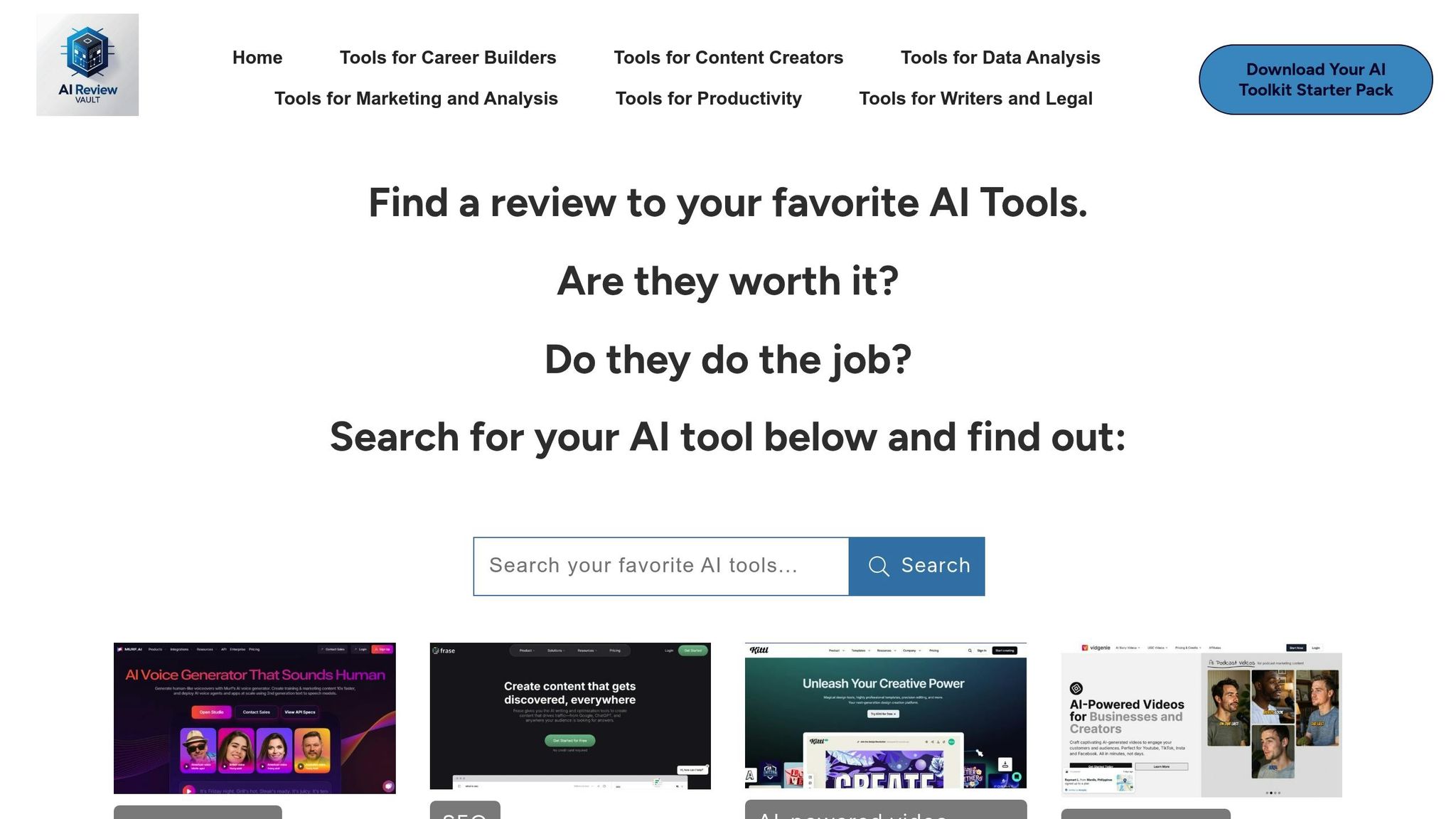
With the explosion of AI marketing tools in 2025, finding the perfect fit for your needs can feel like searching for a needle in a haystack. That’s where AI Review Vault steps in, offering expert reviews to simplify your decision-making process and help you build an effective marketing toolkit.
About AI Review Vault
AI Review Vault is a go-to blog platform for anyone looking to navigate the complex world of AI tools. It provides detailed reviews and insights across a variety of categories, including voice generation, video creation, SEO optimization, graphic design, and content creation.
The platform doesn’t just tell you what a tool can do – it shows you how it fits into practical marketing workflows. From marketing automation to workflow optimization and even career development applications, the reviews are packed with real-world use cases, feature breakdowns, and side-by-side comparisons.
Everything is neatly organized by marketing needs, making it easy to zero in on the tools that matter most to you. Whether you’re enhancing video campaigns or fine-tuning SEO strategies, the structured layout ensures you won’t waste time sifting through irrelevant information.
And when you’re ready to dive deeper, you can explore the flexible pricing plans tailored to different marketing budgets and objectives.
AI Review Vault Pricing Plans
AI Review Vault offers a tiered pricing model, ensuring there’s an option for everyone – from solo marketers to large teams:
| Plan | Monthly Price | Key Features | Limitations |
|---|---|---|---|
| Free Plan | $0 | Basic tool exploration | Watermark on exports |
| Basic Plan | $19 | 1 user, 2 hours of voice generation monthly | 60 voices, limited downloads |
| Pro Plan | $26 | 1 user, 4 hours of voice generation monthly | 120+ voices, commercial use, voice editing |
| Enterprise Plan | Custom Pricing | Team accounts, collaboration tools | Voice cloning, priority support |
The Free Plan is ideal for dipping your toes in, offering basic features to test the platform’s value before committing. It’s particularly useful for small businesses or individual marketers who want to explore without upfront costs.
For $19 per month, the Basic Plan provides access to a solid voice library and moderate generation capabilities, making it a great fit for growing teams that need reliable tools for consistent content creation.
The Pro Plan, priced at $26 per month, unlocks advanced features like commercial usage rights and voice editing, catering to established marketing departments that require high-quality tools for professional campaigns.
Finally, the Enterprise Plan offers custom solutions for larger teams, with premium features like voice cloning and priority support to meet complex needs.
How AI Review Vault Helps Marketers
AI Review Vault goes beyond standard reviews, giving marketers the resources they need to make smart, informed decisions. The platform simplifies the process of selecting AI tools by offering clear, consolidated reviews that highlight each tool’s strengths and limitations.
With real-world examples and side-by-side comparisons, you can quickly determine whether a tool aligns with your team’s goals and workflows – saving you from costly missteps. For teams operating on tight budgets or schedules, understanding a tool’s limitations upfront ensures that time and money are spent wisely.
Additionally, the platform’s categorized structure supports strategic planning for adopting marketing technologies. Whether you’re building a content creation pipeline or automating campaigns, AI Review Vault helps you identify tools that complement each other, avoiding redundancies or conflicts in your stack.
In short, AI Review Vault isn’t just a review site – it’s a roadmap for integrating AI tools seamlessly into your marketing strategy.
The Future of AI Marketing
The marketing world is transforming at a breakneck pace, thanks to AI tools that bring powerful advantages to businesses ready to embrace them. Companies that integrate these technologies into their strategies are setting themselves up to outpace the competition.
Key Points to Remember
Building on earlier insights, here are some important ideas to keep in mind as you plan for what’s next in AI marketing.
AI tools are reshaping the way we create content, manage campaigns, and interact with customers. By automating repetitive tasks, these tools free up time and energy, allowing marketers to focus on creativity and strategy. They also make scalable personalization a reality, opening doors to deeper customer connections.
Fast forward to 2025, and the most successful marketing teams will be those that see AI not as a replacement for human creativity but as a way to amplify it. These tools will handle the mundane, time-consuming work, leaving more room for innovative thinking and problem-solving.
Another major benefit of AI is its ability to cut costs. Tasks that once required large teams can now be handled efficiently with AI tools, giving smaller businesses the chance to compete with larger players. This shift levels the playing field, making advanced marketing capabilities more accessible than ever.
Looking ahead, the integration of AI tools will create interconnected marketing ecosystems rather than isolated solutions. This connectivity enhances the effectiveness of each tool, creating a ripple effect of benefits across your entire marketing strategy.
New Trends in AI Marketing
As AI continues to evolve, several emerging trends are set to redefine the marketing landscape:
- Hyper-personalization is moving beyond simple demographic targeting. AI can now analyze behavioral patterns, purchase histories, and engagement data to craft highly tailored experiences for individual customers. What once seemed impossible at scale is now both achievable and efficient.
- Predictive analytics is becoming more advanced, enabling marketers to anticipate customer needs and market shifts with precision. These tools can flag potential churn risks, suggest pricing strategies, and even forecast campaign outcomes before significant resources are committed.
- Voice and conversational AI are gaining traction. With natural language processing, AI tools are creating user interfaces that feel intuitive and generating content that sounds more human. This makes these tools easier to use, even for marketers without technical expertise.
- Real-time optimization is no longer a luxury – it’s becoming the norm. AI can now tweak campaigns, content, and strategies instantly based on performance data, reducing delays between identifying issues and implementing fixes.
- Cross-platform intelligence is emerging as AI tools gain a better understanding of customer journeys across multiple channels. This comprehensive view enables more cohesive and effective marketing strategies that account for the complexities of modern consumer behavior.
Staying Competitive with AI Marketing Tools
To keep pace with these advancements, marketers need to adopt forward-thinking strategies that align with the evolving technology.
AI tools are constantly improving, and new options are popping up all the time. A quarterly reassessment of your marketing stack is essential to ensure you’re not relying on outdated tools. What’s cutting-edge today could be standard practice in just a few months.
Building AI literacy within your team is also key. While no one needs to become a tech expert, understanding what these tools can – and can’t – do will help you make smarter decisions and spot opportunities for growth.
Don’t be afraid to experiment. Many AI tools are affordable and easy to test, so set aside time and resources to try out new solutions that could give you an edge.
Finally, prioritize data quality. AI tools are only as effective as the data they’re working with, so investing in clean, well-organized data systems will pay off as your reliance on AI grows.
The marketing teams that thrive in this AI-driven era will be those that treat AI adoption as an ongoing process, not a one-time project. By staying adaptable and focused on building meaningful connections with customers, you’ll be well-positioned to succeed in this ever-changing landscape.
FAQs
How can small businesses use AI marketing tools effectively on a tight budget?
Small businesses don’t need hefty budgets to tap into the power of AI marketing tools. A smart way to start is by exploring free plans or trial versions offered by many platforms. These options let you test the waters and see what works for your business before committing to a paid subscription.
It’s all about focusing on what your business needs most. For instance, AI-driven content creation tools, like writing assistants or graphic design software, can help you produce high-quality materials quickly and efficiently. Similarly, affordable tools for automating tasks, such as email campaigns or social media management, can simplify your processes without stretching your budget.
The key is to prioritize tools that align with your goals and deliver the biggest impact. This approach allows you to boost your marketing efforts while keeping costs under control.
How can I seamlessly integrate AI marketing tools into my current workflows?
To seamlessly incorporate AI marketing tools into your current workflows, the first step is to assess the compatibility of your existing tools. Look for features like API access, standardized data formats, and secure authentication protocols. These elements ensure that your tools can communicate effectively and function as a cohesive system.
Another critical aspect is maintaining clean, real-time data pipelines. AI tools rely on accurate and up-to-date data to produce the best results. Pinpoint repetitive tasks in your workflow – like email scheduling, content optimization, or data analysis – and let AI take over these processes. By aligning AI’s capabilities with your marketing objectives, you can simplify operations and deliver campaigns that pack a punch with less effort.
How do AI marketing tools help create personalized campaigns and boost customer engagement?
AI marketing tools empower brands to create highly customized campaigns by examining customer behavior, preferences, and interactions as they happen. This allows businesses to deliver content, recommendations, and offers that align with each customer’s unique interests, making their experience feel more engaging and relevant.
In addition, these tools simplify audience segmentation by automatically identifying key customer groups with high potential value. They help craft campaigns specifically designed to meet the needs of these segments. By automating these tasks, AI doesn’t just make personalization easier – it strengthens customer relationships and boosts the overall impact of marketing efforts.